

The Death Penalty in 2000: Year End Report
Posted on Dec 19, 2000
- New Revelations about Death Penalty Reverse Years of Division
- Executions
- Governor Validates Death Penalty Concerns
- Public Opinion
- A Broken System
- Particular Problem Areas
- Race and Executions
- Major Developments
- Conclusion
2000 Year End Report: A Watershed Year of Change
New Revelations about Death Penalty Reverse Years of Division Up
The year 2000 was perhaps the most significant single year affecting death penalty opinion in United States history. A broad change in the way the American public views capital punishment was precipitated by a steady sequence of eye-opening events, including releases from death row, reports on the unfairness of the process, and governmental action to limit or halt the death penalty.
Former supporters of the death penalty joined long-time critics in raising concerns about the accuracy and fairness of capital punishment in America. More conservative voices, such as those of Rev. Pat Robertson, Oliver North, new Congressman Tom Osborne of Nebraska, columnist George Will, and others voiced strong criticisms of the death penalty. The risk of taking innocent lives and the gross inequities in the way the death penalty is applied have led to a new consensus that the system is seriously broken.
Executions Up
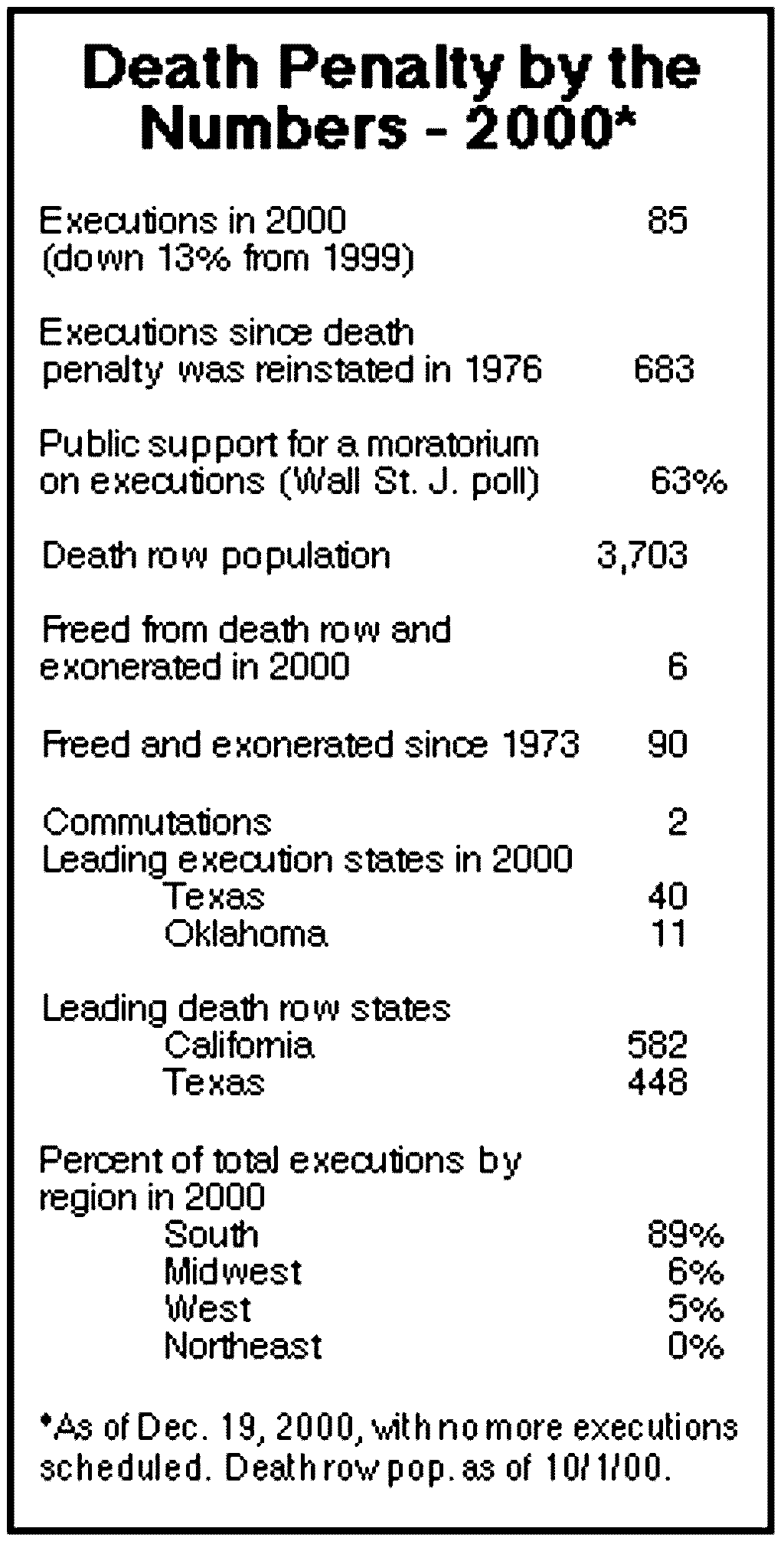
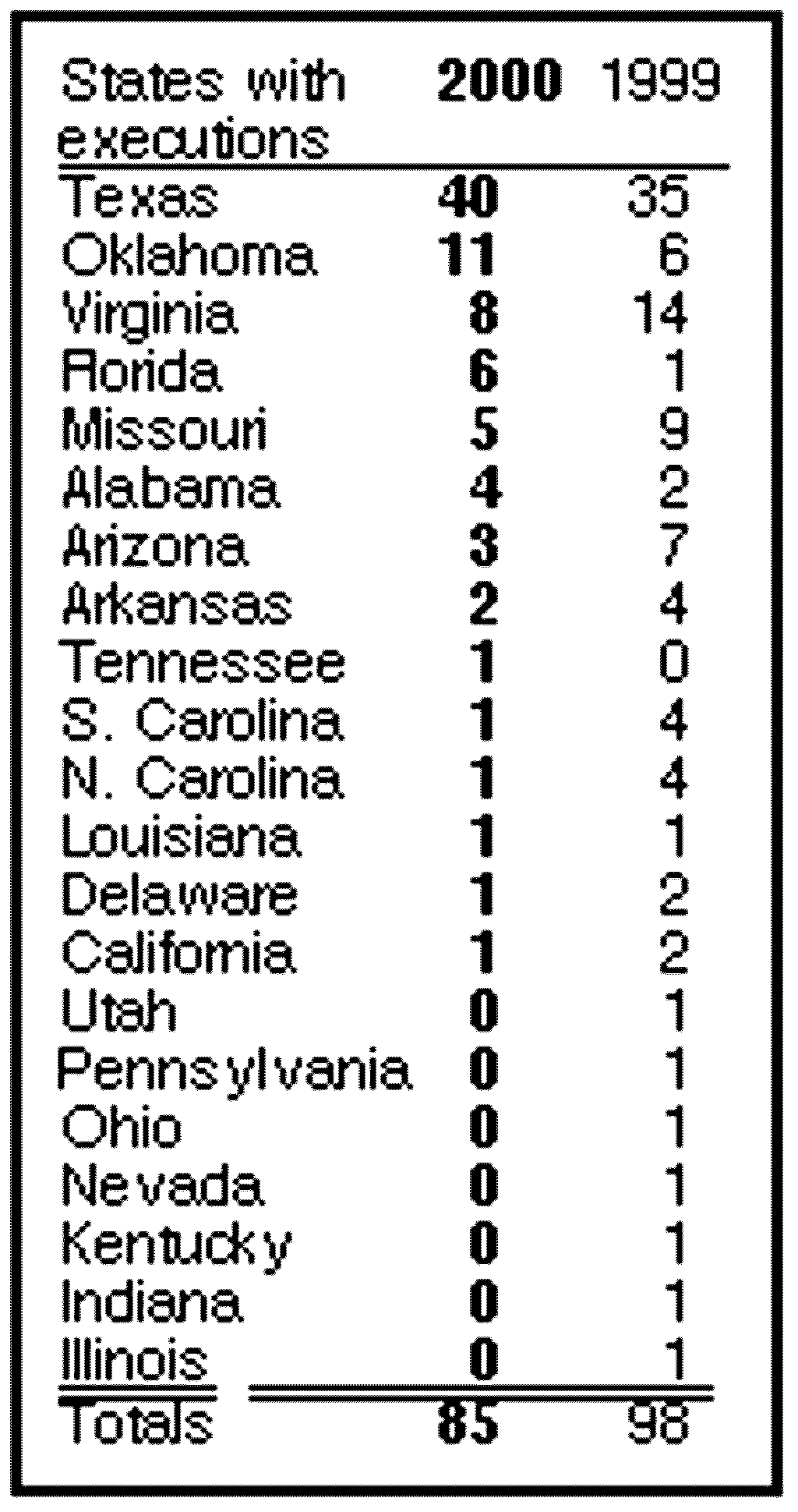
Executions in 2000 declined 13% from the previous year, but still remained high at 85, the second highest number since the death penalty was reinstated in 1976. A closer look at these executions shows that almost 90% occurred in the South. Only 3 states (Arizona, California and Missouri) outside of the South conducted an execution this year. Texas, alone, with 40 executions, accounted for almost as many executions as all the rest of the states combined.
But the larger story is the reversal of years of pressure to speed up executions. From the declaration of a moratorium on all executions in Illinois by a pro-death penalty Republican governor, to the intervention by the Clinton administration to stop the first federal execution in almost forty years, this has been a year in which skepticism about the death penalty process has grown considerably.
Governor Validates Death Penalty Concerns Up
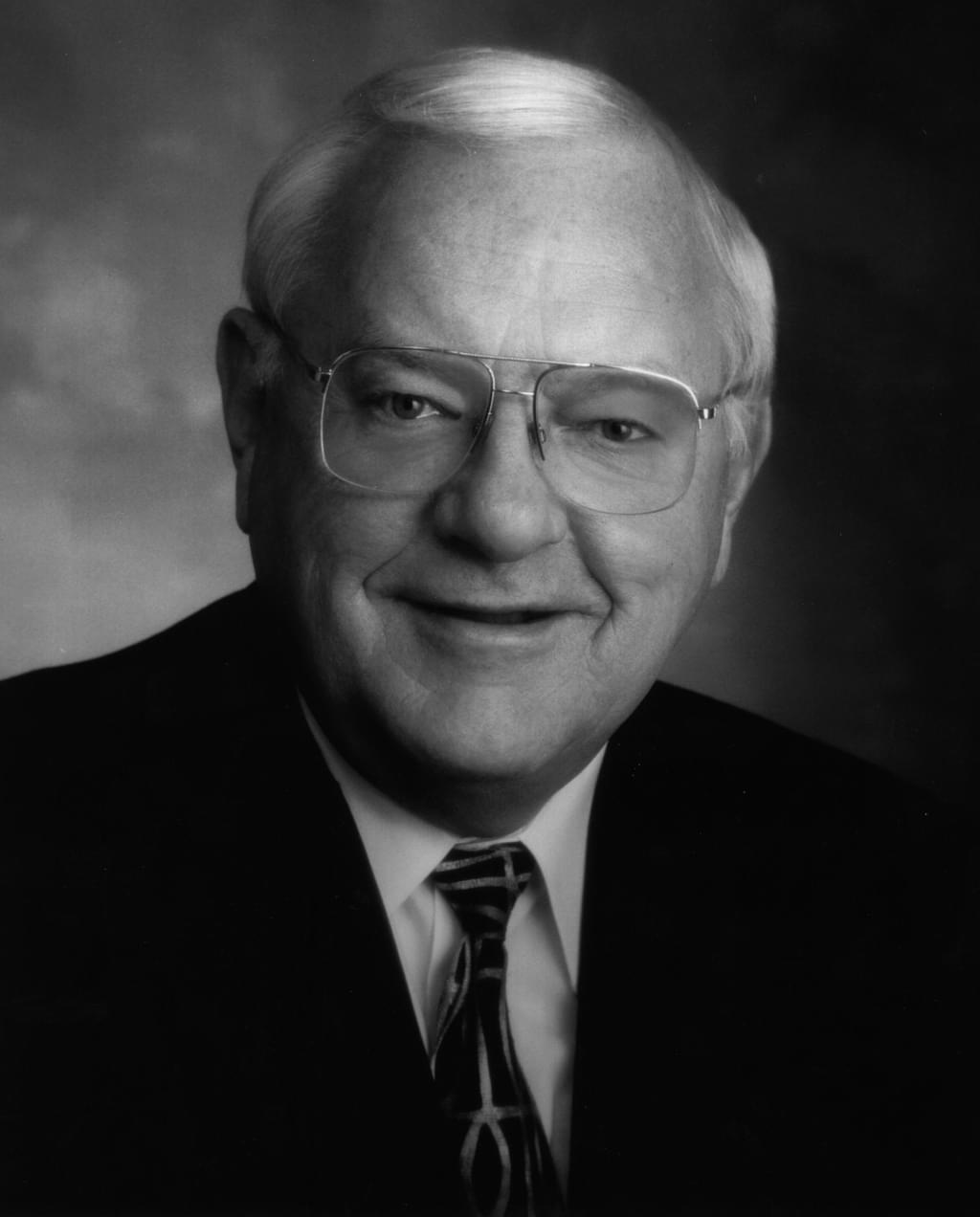
In Illinois, the 13th exoneration of a death row inmate during the same period that the state had executed 12 people became the incentive for Governor George Ryan to announce in January: “[U]ntil I can be sure with moral certainty that no innocent man or woman is facing a lethal injection, no one will meet that fate.” (Chicago Tribune, 2/1/00). Gov. Ryan appointed a blue-ribbon commission to investigate why so many errors were being made in capital cases, and specifically allowed for the possibility that the death penalty will be abandoned altogether.
Governor Ryan’s action was followed swiftly in February by the introduction in Congress of a broad bill to address serious problems in the handling of death penalty cases. Senator Patrick Leahy (D-VT), along with Republican and Democratic co-sponsors in the Senate and House, called for the passage of The Innocence Protection Act to ensure access to DNA testing and better representation for defendants facing the death penalty.
Public Opinion Up
Also in February, the Gallup Poll revealed that public support for the death penalty had dropped to its lowest level in 19 years. Support dropped 14 percentage points from its high in 1994 to a level of 66%. Support declined even further when respondents were allowed to choose life without parole as an alternative sentence. The Poll found that 65% of Americans agree that a poor person is more likely than a person of average or above average income to receive the death penalty. (Gallup Poll, February 8-9, 2000)
Other polls throughout the year confirmed the shift in public support:
- 64% of Americans support a moratorium on executions until issues of fairness in capital punishment can be resolved
- 89% support providing access to DNA evidence in capital cases
- 83% support providing qualified, experienced attorneys in capital cases(Peter Hart Research and American Viewpoint, 9/14/00)
- A Harris Poll found that support for the death penalty dropped to 64% this year, down from 75% in 1997 and 71% in 1999. The poll also found that 94% believed that some innocent people have been convicted of murder. (8/2/00)
- A CNN/USA Today/Gallup Poll shows that only a slim majority (51%) of Americans believe the death penalty is applied fairly. In addition, 80% believe an innocent person has been executed in the United States in the past five years, and 46% believe that an innocent person has been executed in Texas during George W. Bush’s tenure as governor. (6/30/00)
- According to an ABCNEWS.com telephone survey, support for the death penalty is dropping. Support has fallen from a high of 77% in a 1996 poll to 64% now. Support drops even further, to below 50%, when the alternative punishment of life in prison without parole is offered. (1/19/00)

A Broken System Up
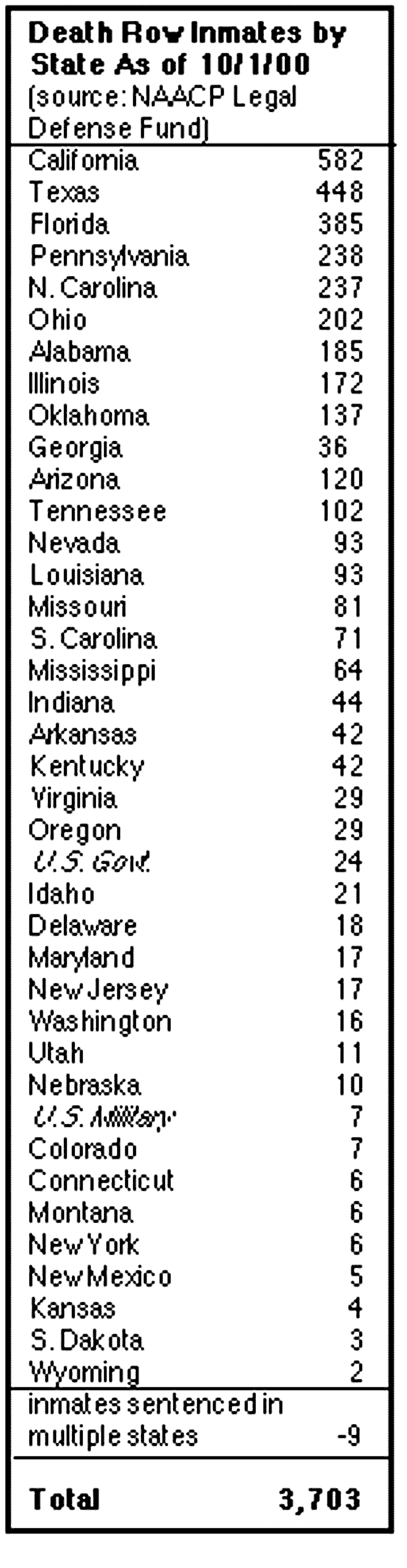
In June, the most comprehensive review of modern death sentencing was published by researchers at the Columbia University Law School. The study, “A Broken System: Error Rates in Capital Cases, 1973-1995,” examined every completed death penalty appeal over a 23 year period. This was not a study about innocence, but about the process which has led to 682 executions and an expanding death row of 3,703 people. The study asked: How carefully were the original trials conducted, and can we have confidence in their results?
The answer according to the study’s author, Professor James Liebman, is that the great majority of these trials were conducted in violation of basic due process, and that we can have little confidence that all of the mistakes were caught in the often hit-and-miss appeals process. In 68% of all completed cases, a reviewing court found serious error requiring the death sentence or underlying conviction to be overturned, necessitating a re-trial. From a sample of the cases that were retried after correcting for the errors, the death penalty was widely repudiated: 82% of the defendants did not receive the death penalty and 7% were completely exonerated. Such a system was rightly called “broken.”
Other reports were equally powerful in exposing the flaws of the death penalty system. The book Actual Innocence, by Barry Scheck, Peter Neufeld and James Dwyer, showed the power of DNA in reversing convictions that had been thought to be ironclad. Reports on the death penalty in Texas by the Chicago Tribune and the Texas Defender Service revealed critical problems in the country’s leading execution state. Other investigations in six states (Arizona, Maryland, North Carolina, Illinois, Indiana, and Nebraska) and on the federal level are in progress may reveal problems prompting calls for a halt to executions or for further reprieves.
Particular Problem Areas Up
Executions of juvenile offenders and defendants with mental retardation continued in 2000, especially in Texas, despite worldwide protests. Four defendants who were under 18 at the time of their crime were executed this year. The European Union, the American Bar Association, the American Association on Mental Retardation, and other human rights organizations made their strong objections to some of these executions known. At the 11th hour, the U.S. Supreme Court did halt the execution of John Paul Penry, a mentally retarded man from Texas. The Court will decide his case later in 2001. The United States was sued in the International Court of Justice by Germany for the execution of two of its citizens in Arizona who were not informed of their rights under the Vienna Convention.
Race and Executions Up
The racial breakdown of the 85 cases resulting in execution this year is as follows:
Defendants
- White - 43 (51%)
- Black - 34 (40%)
- Latino - 6 (7%)
- Nat. Amer. - 2 (2%)
Victims in the underlying murder
- White - 87 (76%)
- Black - 21 (18%)
- Latino - 2 ( 2%)
- Other - 4 ( 3%)
The race of victim numbers show a continuing trend since the death penalty was reinstated of predominance of white victim cases. Despite the fact that nationally whites and blacks are victims of murder in approximately equal numbers, 83% of the victims in cases resulting in executions overall, and 76% this year, have been white. Since this disparity is confirmed in studies which control for similar crimes by defendants with similar backgrounds, it implies that white victims are considered more valuable in the criminal justice system.
The problems of race and the death penalty were reinforced in a study by the U.S. Department of Justice concerning the federal death penalty. Released in September, the study found that 80% of the cases submitted for federal death penalty prosecution involved minority defendants, and that 80% of the resultant federal death row was also made up of minority defendants. In addition, the study highlighted the fact that a few regions of the country were responsible for a disproportionately high number of federal cases, while other major areas produced none.
Major Developments Up
There were many prominent events involving the death penalty this past year. Among them were:
January
- On January 31, Illinois Governor George Ryan declared a moratorium on executions, pending an investigation into the state’s capital punishment system. Governor Ryan’s moratorium received praise from President Clinton and leaders around the country, who urged other state governors to examine their death penalty systems.
- January-March Eighth Amendment challenges to electrocution as a method of execution led to changes in Florida and Georgia. In January, as the U.S. Supreme Court considered hearing arguments regarding the constitutionality of Florida’s electric chair, the state switched its primary method of execution to lethal injection, rendering the case moot. Alabama and Nebraska remain the only states that use electrocution as their sole method of execution. During Florida’s special legislative session, they also attempted to severely cut the appeals process for capital cases, but that bill was declared unconstitutional by the Florida Supreme Court.
February
- A Gallup Poll was released that found the percentage of support for the death penalty in America has been gradually decreasing and is now at 66%, its lowest level in 19 years. This decline in support was mirrored in other recent polls in such states as Illinois, Minnesota, Kentucky, North Carolina, and New Jersey. As support for the death penalty has dropped, and the nation has become more aware of the problems associated with capital punishment, an increasing number of abolition, moratorium, and death penalty reform bills have been introduced throughout the nation.
- On February 11, Senator Patrick Leahy introduced the Innocence Protection Act of 2000 in the U.S. Congress, a bill that would allow DNA testing for all inmates and improve the system of representation for those facing the death penalty. Other provisions include compensation for wrongly convicted inmates released from death row, and the obligation to instruct jurors of the possible sentencing option of life without parole, where applicable. The bill was re-introduced on June 11, with Republican and Democratic co-sponsorship.
March-May
- In March, the New Hampshire House of Representatives passed a bill to abolish the death penalty. In May, the New Hampshire Senate also passed the bill. Although the conservative New Hampshire legislature became the first in over 20 years to vote to repeal the death penalty, the bill was vetoed by Democratic Governor Jeanne Shaheen.
- On May 11, the creation of the National Committee to Prevent Wrongful Executions was announced. The group is comprised of Republicans and Democrats, both for and against the death penalty, who share a common concern that innocent people are at risk of execution because of failures in the legal system. Among its members are William Broaddus (the former Attorney General of Virginia), Beth Wilkinson (one of the chief prosecutors from the Oklahoma City bombing case), and Abner Mikva (former Chief Justice of the U.S. Court of Appeals for the D.C. Circuit). The group, co-chaired by former Florida Supreme Court Justice Gerald Kogan, will investigate current criminal justice practices and procedures, as well as cases of wrongful convictions in capital cases from around the country.
June
- On June 12, Professor James Liebman of Columbia University Law School released a comprehensive study of the death penalty reporting that courts found serious mistakes in 2/3 of all capital cases. The study found that the most common errors were incompetent representation by defense attorneys and prosecutorial misconduct. Veteran political journalist David Broder of the Washington Post cited the Liebman study as one of the outstanding pieces of social research that decisively affect the course of the policy debate.
- On June 23, Gary Graham was executed in Texas, despite vociferous claims that he was innocent. Graham was 17 when he was charged with the 1981 robbery and shooting outside a Houston supermarket. He was convicted primarily on the testimony of one witness, who said she saw the killer’s face for a few seconds through her car windshield, from a distance of 30-40 feet. Two other witnesses who said Graham was not the killer were not interviewed by Graham’s court appointed attorney.
July
- On July 11, the American Bar Association’s new President, Martha Barnett, urged the legal profession to support a moratorium on executions. “I am putting together a call for action,” said Barnett, asking the nation’s lawyers to support the ABA’s 1997 resolution calling for the suspension of the death penalty. She also cited racial bias, and the execution of the mentally retarded and juvenile offenders as problems associated with capital punishment. (NY Times, 7/11/00)
September
- On September 12, a review of the federal death penalty by the United States Department of Justice found numerous racial and geographic disparities. The report revealed that 80% of the cases submitted by federal prosecutors for death penalty review in the past five years have involved racial minorities as defendants. In more than half of those cases, the defendant was African-American. Attorney General Janet Reno said she was “sorely troubled” by the results of the report and has ordered United States Attorneys to help explain the racial and ethnic disparities.
The report also found that 40% of the 682 cases sent to the Justice Department for approval to seek the death penalty were filed by only five jurisdictions. (NY Times, 9/12,13/00) - In response to the release of the Justice Department’s report, Senator Russ Feingold introduced the Federal Death Penalty Moratorium Act of 2000. The bill would impose a moratorium on federal executions pending a review of the federal death penalty system.
October
- When DNA tests confirmed his innocence after 17 years in prison, including9 years on death row, Earl Washington was granted an absolute pardon by Virginia Governor Jim Gilmore for the 1982 rape and murder of a Culpeper County woman. Washington, who suffers from mental retardation, was cleared when DNA tests showed that he did not rape the victim.
Washington’s exoneration marks the first time in Virginia that an innocent death row inmate has been cleared, and is the 88th in the nation since the death penalty was reinstated. Washington was the 9th inmate to be exonerated of a capital crime based on DNA testing. - On October 20, William Nieves was freed from death row when a Philadelphia jury acquitted him of a 1992 murder. Nieves was convicted in 1994, but maintained his innocence. In 1997, the Pennsylvania Supreme Court held that Nieves was inadequately represented at his first trial and granted him a new trial. Nieves was the 89th person freed from death row since 1973, and the 5th in 2000.
November
- Just hours before his execution on November 22nd, North Carolina death row inmate Marcus Carter had his sentence commuted to life in prison without parole by Governor Jim Hunt. Hunt stated that he would not allow the execution to go forward, citing questions about the fairness of Carter’s trial. This was the second commutation of a death sentence in 2000. Earlier in the year, Governor Parris Glendening of Maryland commuted the death sentence of Eugene Colvin-el to life without parole.
- On November 27, the U.S. Supreme Court agreed to hear an appeal by Texas death row inmate John Paul Penry, whose execution had been stayed by the Court on November 16. Penry’s case is synonymous with the debate about executing defendants with mental retardation, and the Court said it will use the case to clarify how much opportunity jurors in death penalty cases must have to consider the defendant’s mental capacity. Penry’s I.Q. has been tested between 50 and 63, and he has the mental abilities of a six-year old.
December
- Citing the findings of a Justice Department study showing racial and geographic disparities in the federal death penalty, President Clinton granted a six month reprieve to Juan Raul Garza, who was scheduled to be executed on December 12. “I am not satisfied that, given the uncertainty that exists, it is appropriate to go forward with an execution in a case that may implicate the very issues at the center of the uncertainty,” said President Clinton. (NY Times, 12/8/00) Considerable opposition to the execution had been expressed by major civil rights leaders, religious organizations, and legal experts from around the country.
- Texas set the record for the most executions by a single state in a year when it executed its 40th inmate in 2000. Twenty-four out of the 38 death penalty states had no executions this year.
- Another death row inmate, Frank Lee Smith, was exonerated in December after DNA testing, but Smith died on death row of cancer before he was cleared. Smith spent 14 years on death row and came close to execution. Florida has had 20 death row inmates exonerated since 1973, 50% more than in Illinois, which has imposed a moratorium on all executions. This was the 90th exoneration of a death row inmate and the 6th this year.
- Finally, and fittingly, the Secretary General of the United Nations, Kofi Annan, issued a call for a worldwide moratorium on the death penalty on December 18 after receiving a petition signed by 3.2 million people seeking an end to executions. “The forfeiture of life is too absolute, too irreversible,” he said, “for one human being to inflict it on another, even when backed by legal process. And I believe that future generations, throughout the world, will come to agree.” (Wash. Post, 12/19/00)
Conclusion Up
The year 2000 produced a series of developments that dramatically shifted the public’s attitude about the death penalty. Less than a decade ago politicians were calling for speedier executions and a broader use of the death penalty, but today they are responding to a public demand for greater assurances that the death penalty be administered accurately and fairly, if it is to continue at all.
The often polarized debate about the death penalty has moved from a conservative versus liberal divide to one in which greater numbers are troubled by the increasingly disturbing reports about capital punishment in the U.S. Innocent people being discovered on death row, the excessive zeal in which some capital cases have been pursued despite countervailing evidence, and the unfairness of a punishment which seems to be decided, or at least influenced, by race, by geography or by the lottery of being assigned an ineffective attorney, have led to a conclusion that the system is broken.
Next year, states will be considering a variety of proposals for reform, for further study, for halting executions, and even for abolishing the death penalty altogether. The public’s tolerance for risking innocent lives in order to preserve the death penalty has greatly diminished. The international community has for some time been calling upon the U.S. to live up to its commitment to human rights by confronting the injustices of the death penalty. Now national religious leaders, civil rights organizations, and legal experts are joining with former proponents of capital punishment to call for a radical re-thinking of executions as a legitimate form of punishment in the U.S.