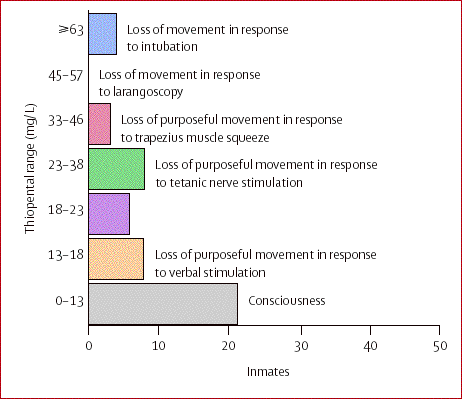
A team of medical doctors reported in the British medical journal The Lancet that in 43 of 49 executed inmates (88%) studied, the anaesthetic administered during lethal injections was lower than that required for surgery. Toxicology reports from Arizona, Georgia, North Carolina, and South Carolina revealed that post-mortem concentrations of thiopental in the blood were below typical surgery levels, and in 21 inmates (43%) the concentrations of thiopental in the blood were consistent with awareness. Their investigation of lethal injection practices from several states found that the guidelines for delivering the essential anaesthesia drug thiopental are flawed and that some inmates might experience awareness and suffering during their execution. In Texas and Virginia, the researchers found that those administering thiopental during lethal injections had no training, and that the drug was administered remotely with no monitoring for anaesthesia. The study also found that in these states no records were kept regarding the administration of thiopental and no peer-review was done. The report concludes, “Failures in protocol design, implementation, monitoring and review might have led to the unnecessary suffering of at least some of those executed. Because participation of doctors in protocol design or execution is ethically prohibited, adequate anaesthesia cannot be certain. Therefore, to prevent unnecessary cruelty and suffering, cessation and public review of lethal injection is warranted.” (The Lancet, Volume 365, Page 1412, April 16, 2005). See Methods of Execution.
- Death Penalty Information Center (2025, March 14). MEDICAL JOURNAL, THE LANCET: Inmates Probably Conscious During Lethal Injections. Retrieved October 25, 2026, from https://deathpenaltyinfo.org/medical-journal-the-lancet-inmates-probably-conscious-during-lethal-injections
- Death Penalty Information Center. “MEDICAL JOURNAL, THE LANCET: Inmates Probably Conscious During Lethal Injections.” Last modified March 14, 2025. Accessed October 25, 2026. https://deathpenaltyinfo.org/medical-journal-the-lancet-inmates-probably-conscious-during-lethal-injections.
- Death Penalty Information Center. “MEDICAL JOURNAL, THE LANCET: Inmates Probably Conscious During Lethal Injections.” Death Penalty Information Center, 14 Mar. 2025, https://deathpenaltyinfo.org/medical-journal-the-lancet-inmates-probably-conscious-during-lethal-injections. Accessed 25 Oct. 2026.