Race Plays Powerful Role in Washington State Death Penalty Cases
Race plays a significant role in who receives the death penalty in Washington. Research compiled by the Washington Death Penalty Assistance Center, revealed that death notices have never been filed in a case with a white defendant and a black victim, while such notices have been filed in 42% of murder cases with a black defendant and a white victim. Of the 10 individuals currently on death row in Washington, nine cases involved a white victim and none involved a black victim. In addition, every juror that convicted and sentenced the black defendants was white. (Washington Death Penalty Assistance Center, May 2003)
Technicality Means No Review and Probable Execution
The U.S. Court of Appeals for the 4th Circuit has rejected an appeal filed on behalf of North Carolina death row inmate Kenneth Rouse. Without disputing the merits of his claim, the court ruled that it would not hear the case because the motion was filed one day after an appeal deadline established by a 1996 federal law. In its ruling, the court wrote that the fact that Rouse faces the death penalty is no reason to give leeway in meeting the federal deadline. Rouse’s attorneys are requesting a new trial because a juror in Rouse’s case failed to disclose that his own mother had been murdered and sexually assaulted. The attorneys note that the juror, who is white, also used a racial epithet to describe Rouse, who is black, and that the juror expressed racist attitudes. (The Herald Sun, August 11, 2003). The dissent in the case noted that the juror carefully crafted his responses to voir dire questions because he wanted to be on the jury that judged Rouse.
Purposeful Discrimination in Capital Sentencing
“Purposeful Discrimination in Capital Sentencing” by David V. Baker examines the issue of race and capital sentencing in the context of three U.S. Supreme Court death penalty decisions - Furman v. Georgia, Gregg v. Georgia, and McCleskey v. Kemp. After his review of practical strategies to improve the fairness of the death penalty process, Baker concludes that court efforts have failed to eliminate race as a strong predictor in death sentencing. (5 Journal of Law & Social Challenges 189 (2003)).
Researchers Find Prejudice Shapes Support for Death Penalty
In “Why Do White Americans Support the Death Penalty?,” American University researchers Joe Soss, Laura Langbein, and Alan Metelko examined whether racial attitudes play a role in white support for the death penalty. The researchers found that white support for the death penalty in the United States has strong ties to anti-black prejudice, and in some geographic areas racial prejudice emerges as the strongest predictor of white death penalty support. Soss, Joe, et al.: “Why Do White Americans Support the Death Penalty? “; 65 The Journal of Politics 397 (2003)
California Legislator Calls for Special Commission to Review Death Penalty
California Senator Gloria Romero of Los Angeles, who chairs the Select Committee on the California Correctional System, is calling for a special commission to study the state’s death penalty. After a Senate hearing featuring more than a dozen witnesses, including prosecutors, defense lawyers, prison officials, relatives of murder victims, and former Illinois Governor George Ryan, Romero raised specific concerns about racial and geographic disparities in the imposition of the death penalty. She stated, “At a time when Gov. Davis is proposing that we build a state-of-the-art, $220 million death row, even though we have a $34-billion budget deficit, I think it is an appropriate moment to study (how the death penalty is working in California).” (Los Angeles Times, April 23, 2003)
Pennsylvania Supreme Court’s Committee Calls for Moratorium
A report released by the Pennsylvania Supreme Court’s Committee on Racial and Gender Bias in the Justice System recommends that Governor Ed Rendell and state lawmakers enact a moratorium on the death penalty to provide an opportunity to further review the impact of race in death penalty sentences. “Empirical studies conducted in Pennsylvania to date demonstrate that, at least in some counties, race plays a major, if not overwhelming, role in the imposition of the death penalty,” the report states. The Committee, created in 1999, also recommended passage of a Racial Justice Act, statewide standards for prosecutorial discretion, and statewide standards for both trial and appellate lawyers in capital cases. (Associated Press, March 4, 2003) Read the Committee’s report. DPIC has drawn key excerpts from the death penalty chapter of the Committee’s report. Click here for Excerpts page.
Death Penalty Rarely Used in Cases Involving Hispanic Victims
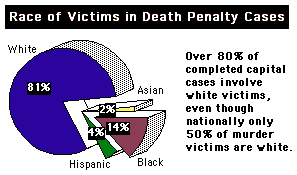
Although Hispanics (of any race) represent approximately 12% of the U.S. population, a recent report by the Bureau of Justice Statistics (BJS) states that Hispanics are victims of homicide at a rate that is 47% larger than the general population. Despite this statistic, the death penalty is rarely used when an Hispanic is the victim in the underlying murder. According to the NAACP Legal Defense and Educational Fund, less than 4% of the executions since 1976 involved murders with Latino victims. Over 80% of the death penalty cases involved white victims. (See BJS, “Hispanic Victims of Violent Crime, 1993-2000” (April 2002)).
Racial Discrimination Results in New Trial for Philadelphia Death Row Inmate
A Pennsylvania judge overturned the conviction of William Basemore, saying the prosecutor engaged in a pattern of racial discrimination during jury selection. The prosecutor eliminated 19 potential jurors, all of whom were black. The judge found that there was “a conscious strategy to exclude” black jurors. The same prosecutor, Jack McMahon, had been videotaped in the 1980s instructing a group of young prosecutors on how to exclude certain types of black jurors from trials. (Associated Press, Dec. 20, 2001). Commonwealth v. Basemore.
Kentucky overwhelmingly passed a bill which would allow defendants in capital cases to use statistical evidence of racial discrimination to show that race influenced the decision to seek the death penalty. If the judge finds that race was a factor, the death penalty would be barred. (Herald-Leader, 3/31/98). The governor’s signature makes Kentucky the first state to pass such a “Racial Justice Act.” (text of bill). The U.S. House of Representatives has passed a similar bill on two occasions, but it has been defeated in the Senate. Kentucky also voted to give inmates a choice of lethal injection or the electric chair and became the latest state to adopt a sentence of life without parole. Those sentenced after March 31, 1998 will be executed by lethal injection